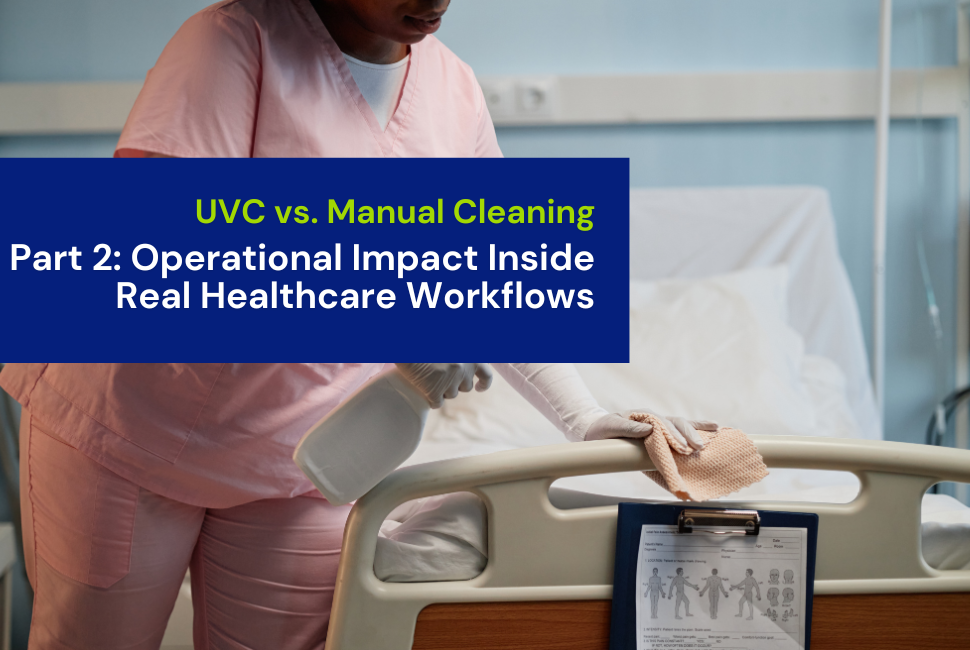
Manual Cleaning: Effective on Paper, Fragile in Reality
Manual cleaning and chemical disinfection are still the backbone of environmental hygiene. Most facilities have protocols, checklists, defined dwell times, and approved chemical products. In theory, the process is straightforward and effective.
In practice, healthcare operations are never that controlled.
Environmental services teams are asked to turn rooms quickly while demand climbs. Nurses and techs may spot clean in a hurry between cases. New staff rotate in, training refreshers slip, and even experienced teams get fatigued by the end of a shift. Under that kind of pressure, small deviations become normal: a shorter dwell time here, a skipped surface there, a high-touch area that doesn’t get the attention it needs.
Manual cleaning remains essential, but it is inherently vulnerable to human factors. As patient throughput rises and room turnover accelerates, relying on manual cleaning alone can leave gaps, especially in ORs, ICUs, EDs, and other high-risk areas.
How UVC Acts as an Operational Equalizer
UVC disinfection doesn’t replace manual cleaning; it helps standardize what happens after the visible soil is removed.
Once the room has been cleaned by hand, a UVC system can deliver the same calibrated dose every time, regardless of who’s on duty or how busy the floor is. It doesn’t get tired, distracted, or rushed. It doesn’t forget the far corner of the room or the underside of a bedside table. When it’s placed correctly and allowed to complete its cycle, the disinfection result is consistent.
This predictability is a major operational advantage. Instead of environmental hygiene depending entirely on the variability of human performance, UVC introduces a layer of reliability. It does the same job at 3 a.m. that it does at 3 p.m., even when staffing is tight or shifts are stretched.
Integrating UVC Into Daily Workflows
The biggest operational question facilities ask is simple: Will UVC slow us down?
The answer depends less on the technology itself and more on how thoughtfully it’s woven into existing workflows. The facilities that see the best operational outcomes don’t try to force UVC into every single space from day one. They start by tying it to natural points in the day where an additional disinfection step makes sense.
For example, UVC is often added as a final step during terminal cleaning in isolation rooms or procedure areas. Once staff clear visible soil and finish chemical disinfection, they place the UVC system, start the cycle, and let the room “finish itself” while they move to another task. Some facilities use UVC at the end of the day in procedure suites, staff lounges, shared equipment spaces, or soiled utility rooms. Others increase UVC use strategically during outbreaks or on units with stubborn clusters of HAIs.
What makes UVC operationally practical is predictability. Staff know where the device is stored, how long standard cycles take, and which types of rooms or situations take priority. Once that routing is clear, UVC becomes part of the normal rhythm rather than an awkward bolt-on.
Safety, Compliance, and Confidence
Introducing any new technology into clinical environments raises understandable safety concerns. UVC, used improperly, can be harmful to eyes and skin. That’s why modern systems are built with multiple safeguards, such as motion sensors that immediately shut off the device when someone enters the room, clear status indicators, and simple controls.
With clear procedures, signage on the door, a quick room sweep before starting the cycle, and basic training, UVC disinfection can be used safely without disrupting clinical workflows. For many infection prevention teams, this actually improves peace of mind. They can be more confident that terminal disinfection is happening as intended, not just as hoped.
UVC also supports compliance from a process standpoint. Cycle times are standardized. Doses are pre-set. Some systems allow usage logging or reporting that helps support audits and quality initiatives. Instead of relying on manual cleaning alone to meet environmental targets, teams can show that an additional, repeatable disinfection step is built into their operations.
Where UVC and Manual Cleaning Work Best Together
Operationally, the most successful facilities don’t think in terms of “UVC vs. manual cleaning”, they think in terms of layered defense.
Here’s one place where a quick list helps clarify how each method fits:
Manual Cleaning Is Best For:
- Removing visible soil, body fluids, and organic material
- Handling spills, discharge events, and spot-cleaning needs
- Non-critical, low-risk spaces where quick wipes are sufficient
UVC Disinfection Is Best For:
- Standardizing terminal disinfection in high-risk rooms
- Reaching surfaces that may be missed or inconsistent manually
- Adding an extra layer of protection during outbreaks or high census
- Reducing chemical reliance where fumes, residues, or contact sensitivity are a concern
In other words, manual cleaning prepares the space; UVC finishes the job.
Getting Staff Adoption Right
Even the most sophisticated UVC system won’t improve operations if it sits idle in a closet.
Adoption depends on how staff perceive the technology. If they see it as an extra step that only slows them down, resistance is inevitable. If they see it as a tool that protects them, supports infection prevention goals, and helps them do their jobs more confidently, use increases naturally.
That shift usually starts with communication. When infection prevention teams explain why UVC is being introduced, reducing exposure to pathogens, supporting antimicrobial stewardship, improving environmental consistency, it becomes easier for EVS, nursing, and clinical teams to connect it to their daily reality. Hands-on training that shows how simple it is to place, start, and complete a cycle goes a long way. Early success stories, such as using UVC to support control of an outbreak or improve disinfection in a difficult unit, help staff see the impact.
When frontline staff understand that UVC is not replacing their work but reinforcing it, adoption transforms from compliance to collaboration.
Operational Resilience in a Changing Environment
Healthcare operations rarely stand still. Seasonal surges, staff shortages, evolving pathogens, and new regulatory expectations are the norm, not the exception. Any infection prevention strategy that depends on perfect conditions is fragile by design.
UVC disinfection adds a measure of operational resilience. It reduces variability in environmental hygiene, supports consistency when staffing is stretched, and can be scaled across different spaces and campuses over time. It gives infection prevention teams another lever to pull when dealing with emerging threats, more complex patient populations, or higher throughput.
In that sense, the operational case for UVC is not about replacing existing protocols, it’s about making them more durable under real-world pressure.
What’s Next: Measuring Real-World Effectiveness
So far in this series, we’ve covered two major dimensions of the decision:
Part 2: The operational side, how UVC fits into daily workflows and supports consistent, scalable disinfection.
In Part 3, we’ll turn to the question that ultimately matters most: How effective is UVC disinfection compared to manual cleaning, and what does the evidence show in real-world environments?
We’ll look at log reduction data, how different pathogens respond to UVC, and how to think about “effective enough” based on the risk level of each space in your facility.
In the meantime, if you’re evaluating where UVC could strengthen your infection prevention strategy, you don’t have to do it in theory.
You can explore our UVC disinfection systems here: https://finsentech.com/solutions/
And if you’d like to discuss how UVC might fit into your facility’s unique workflows, patient population, and risk profile, the Finsen Tech team is ready to help you think it through.